
Choosing a Welding Machine for Small Fabrication and Repair Shops: Why "Enough" Matters More Than "Biggest"
A practical framework for matching amperage, duty cycle, process coverage, portability and controls to the work a small fabrication or repair shop actually performs.
The easiest way for a small fabrication or repair shop to buy the wrong welding machine is to choose for an imagined future workload instead of the jobs that arrive every week. More amperage and more processes can be useful, but unused capacity still occupies floor space and ties up capital.
A better decision starts with the real job mix: materials, thicknesses, process changes, available input power, portability and the length of continuous welds.
Start With the Shop's Actual Work Pattern
A repair shop that welds intermittently has different needs from a production shop running long beads for most of the day. Intermittent work often values portability, quick setup and process flexibility. Continuous production places more weight on duty cycle, service support and repeatable output.
List the previous three to six months of jobs. Record how often the shop used MIG, Stick, TIG, aluminum welding and cutting, plus the typical material thickness. That record is a better sizing tool than a feature list.
Match Process Coverage to Paid Work
MIG is fast and covers a wide range of steel, stainless and aluminum fabrication. Stick tolerates outdoor work and less-than-perfect surfaces. TIG offers the highest level of heat control and finish quality but requires more operator skill. Plasma cutting can save preparation time when cutting is part of the normal workflow.
The important distinction is not whether a machine lists TIG, but what type of TIG it provides. Lift TIG is useful for many steel and stainless tasks. Professional aluminum TIG normally requires AC output and benefits from HF non-contact starting and adjustable AC controls.
Gas Connections Can Become a Daily Productivity Issue
Switching from MIG to TIG or plasma cutting may require a different shielding gas or compressed air. On a machine with one shared connection, every change can involve disconnecting, reconnecting and purging lines.
Dedicated connections have the most value in shops that change processes several times a day. A shop that stays on one process for most of the week may not recover the added cost or complexity.
Size Duty Cycle for the Way the Shop Welds
Duty cycle is measured over a ten-minute period. A rating of 200 A at 40% means four minutes of welding at that output followed by the cooling time defined by the manufacturer.
Miller's farm and ranch selection guidance notes that a 130–150 A MIG unit at 30% duty cycle can cover many light repairs up to about 3/16 inch, while heavier repair and fabrication can justify a 200–250 A MIG unit at 40–60%. The correct range still depends on joint design, weld position, material and required penetration.
Repair work often includes fitting, repositioning, inspection and grinding between short welds. In that rhythm, maximum industrial duty cycle may not be the limiting factor. Long continuous seams and production runs change the calculation.
Choose an Interface the Whole Shop Can Use
Synergic programs help less-experienced welders reach a usable starting point. Experienced operators still need direct access to voltage, wire-feed speed, arc characteristics and advanced TIG controls.
A screen plus physical knobs can serve both groups: the screen makes the complete setup visible, while knobs allow quick tactile adjustment. Saved jobs and clear status information are especially useful when several people share one machine.
Use Comparable Products Correctly
The Miller Multimatic 215 is a portable DC-output MIG, flux-cored, DC TIG and Stick platform. It should not be described as an AC/DC TIG machine. Miller's relevant AC/DC comparison is the Multimatic 220 AC/DC, which supports MIG, flux-cored, Stick, AC TIG and DC TIG and is rated up to 230 A depending on process.
The ESAB Rebel EMP 205ic AC/DC is another compact multi-process reference. ESAB lists MIG/MAG, Stick and AC/DC TIG with a maximum 205 A output. These products show that useful process consolidation is possible, but each model still has a specific output range, duty cycle, input requirement and feature set.
Where NEXA ULTRA Fits
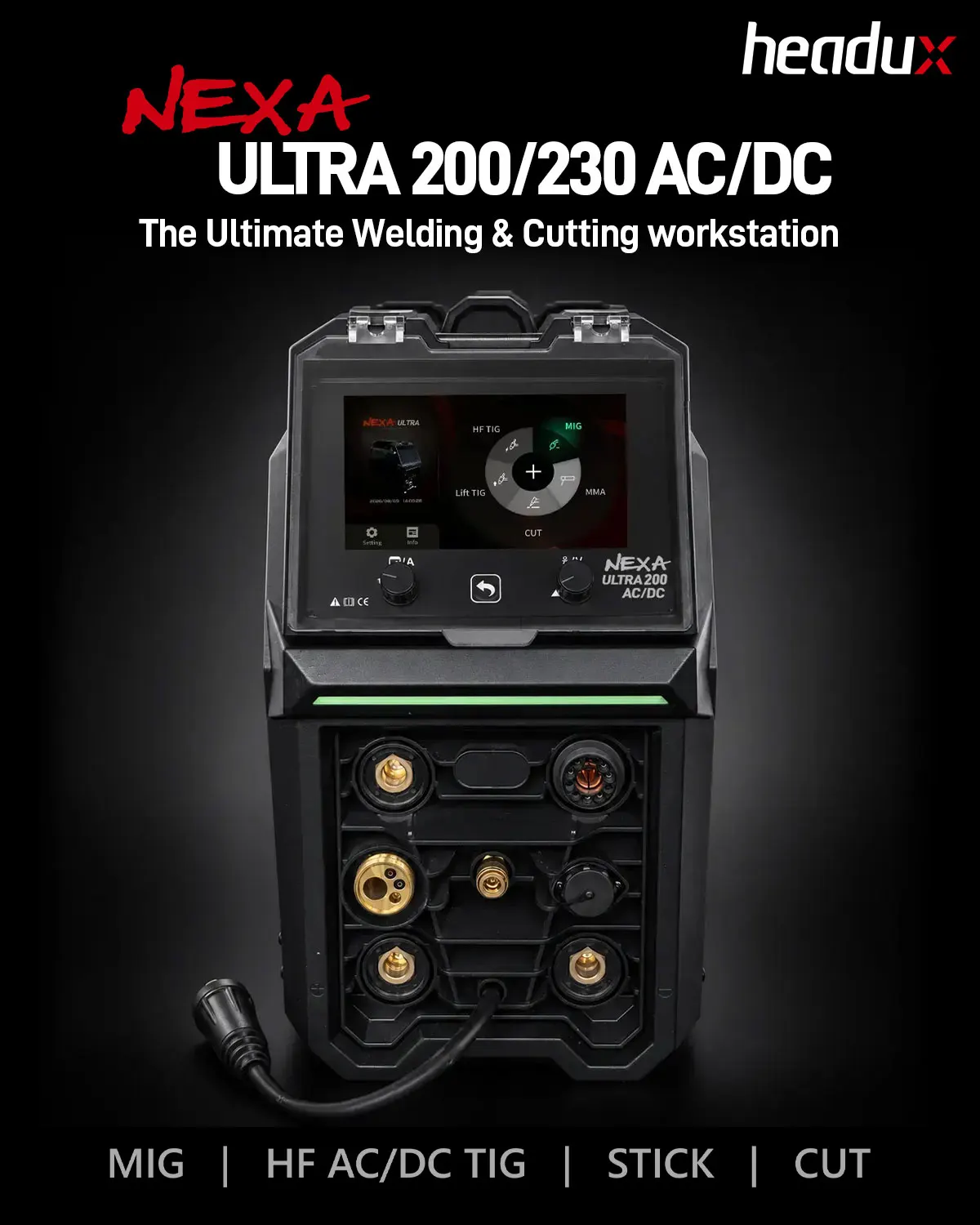
NEXA ULTRA 200/230 AC/DC is intended for operators whose job mix genuinely spans multiple processes. The platform combines DC MIG, Pulse and Double Pulse MIG, HF AC/DC Pulse TIG, Stick, Pulse Stick and non-HF plasma cutting. A 7-inch touchscreen sits beside physical knobs, and the current feature set includes wireless and Bluetooth connectivity, a four-gear wire drive and generator compatibility.
For a repair shop moving between aluminum components, steel frames and cutting work, consolidating those processes can reduce the number of separate machines to purchase and maintain. For a shop that spends nearly all its time on carbon-steel MIG, much of that capability may remain unused.
The right machine is therefore not the one with the longest specification sheet. It is the one whose usable processes, output, duty cycle and workflow match the work that keeps the shop busy.